Yoko Ono Greenfield Morning I Pushed an Empty Baby Carriage All Over the City
| Yoko Ono/Plastic Ono Band | ||||
|---|---|---|---|---|
 | ||||
| Studio album past Yoko Ono with Plastic Ono Band | ||||
| Released | 11 December 1970 (1970-12-xi) | |||
| Recorded | x October – half dozen November 1970 "AOS" February 1968 | |||
| Studio | Abbey Road and Royal Albert Hall, London | |||
| Genre |
| |||
| Length | 40:29 | |||
| Label | Apple | |||
| Producer | Yoko Ono, John Lennon | |||
| Yoko Ono chronology | ||||
| ||||
Yoko Ono/Plastic Ono Band is the debut studio album by Japanese artist and musician Yoko Ono, released on Apple Records in December 1970. It was released simultaneously with her husband'south album John Lennon/Plastic Ono Band. Backed by the Plastic Ono Band and, on one track, the Ornette Coleman Quartet, it followed the release of three experimental albums with Lennon and a live album from the 1969 version of the Plastic Ono Band. In the U.s., information technology peaked at number 182 on the Billboard Height LPs nautical chart.
Recording [edit]
With the exception of "AOS", a 1968 recording, Ono's anthology was recorded at Abbey Road Studios during the aforementioned September–October 1970 sessions that produced the John Lennon/Plastic Ono Band album.[2] [three] Also recorded at this fourth dimension was "Between the Takes", which was released on the 1998 CD reissue of Ono'southward Fly anthology.[2] "Greenfield Morn I Pushed an Empty Baby Carriage All Over the City" was based on a sample from a tape of George Harrison playing sitar and a Ringo Starr pulsate break with an added repeat effect[4] plus Ono'southward vocals with a lyric referencing a miscarriage.[v] Ono'due south vocalisations on tracks such as "Why" and "Why Not" mixed hetai, a Japanese song technique from kabuki theatre, with modern rock 'n scroll and raw aggression influenced by the so-popular primal therapy that Lennon and Ono had been undertaking. Co-ordinate to Ono, the recording engineers were in the habit of turning off the recording equipment when she began to perform – which is why, at the end of "Why", Lennon can be heard request "Were you lot gettin' that?"[4]
On 29 February 1968, Ono appeared onstage at London's Royal Albert Hall with Ornette Coleman and his jazz grouping. The performance and their afternoon rehearsal were both recorded; "AOS" was recorded during this rehearsal and included on the album, the but track non featuring the Plastic Ono Band as it existed for the December Ono and Lennon albums. Describing how she met Coleman, Ono has stated:
Ornette was already very, very established and famous and respected guy every bit a musician. And I met him in Paris. The way I met was, I was doing a show and afterwards the show, somebody said, Oh, Ornette Coleman is here and he would like to – okay. Well, hello. Thank you for coming. That kind of thing. And he was saying, Well, okay. And so he said that he was going to get and practice a concert in Albert Hall and would I come and practise it with him considering he thought information technology was kind of interesting what I do.[6]
Release and reception [edit]
| Review scores | |
|---|---|
| Source | Rating |
| AllMusic |   [vii] [vii] |
| Rolling Rock | Positive[eight] |
| Pitchfork | 9.1/10[ix] |
Initially on Apple tree Records, through EMI, Yoko Ono/Plastic Ono Band was released to considerable critical disdain in 1970, at a fourth dimension when Ono was existence widely blamed for disbanding The Beatles. Yoko Ono/Plastic Ono Ring simply hit the lower reaches of the album chart in the United States, failing to chart in the Uk birthday.[3] Notable exceptions were the estimations of Billboard who called information technology 'visionary' and critic Lester Bangs who supported it in Rolling Rock. More than recently, the album has been credited with having an influence on musicians grossly disproportionate to its sales and visibility, akin to that of The Velvet Secret.[ten] [11] David Browne of Entertainment Weekly has credited the album with "launching a hundred or more female person culling rockers, similar Kate Pierson & Cindy Wilson of the B-52s to current thrashers like L7 and Courtney Dearest of Pigsty".
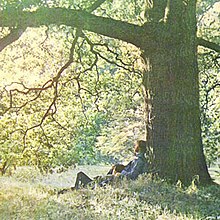
The covers of Yoko Ono/Plastic Ono Band and John Lennon/Plastic Ono Band albums are well-nigh identical. Lennon pointed out the deviation in their 1980 Playboy interview: "in Yoko'south, she'south leaning back on me; in mine, I'1000 leaning on her". The photos were taken with a cheap Instamatic camera on the grounds of Tittenhurst Park (their home at the time) by actor Daniel Richter, who is all-time known for playing Moon-Watcher, the caput apeman in the 1968 science fiction moving-picture show 2001: A Space Odyssey by Stanley Kubrick. At the fourth dimension, Richter lived with Lennon and Ono and worked equally their assistant.
The album was reissued on compact disc by Rykodisc in 1997 with three bonus tracks from the era.[12] An "LP replica" special edition was issued by V2 Records in Nippon in 2007,[xiii] and it was reissued once more on LP, compact disc, and digital download by Secretly Canadian on Nov 11, 2016, with bonus tracks and rare photos.
The title and lyrics to "Greenfield Morning" derive from Ono's 1964 book Grapefruit. An edited version of "Open up Your Box" appeared as the B-side to the UK issue of Lennon's single "Power to the People".
Rail listing [edit]
All songs written by Yoko Ono.
Original release [edit]
Side one
- "Why" – 5:37
- "Why Not" – nine:55
- "Greenfield Morning I Pushed an Empty Baby Carriage All Over the City" – 5:38
Side ii
- "AOS" – seven:06
- "Touch Me" – 4:37
- "Paper Shoes" – 7:26
1997 reissue [edit]
Tracks i–half-dozen per the 1970 release, with the following bonus tracks:
- "Open Your Box" (alternate version) – 7:35
- "Something More Abstract" – 0:44
- "The South Current of air" – 16:38
2017 reissue [edit]
Tracks ane–half dozen per the 1970 release, with the following bonus tracks:
- "Open Your Box" (alternate version) – 7:35
- "Something More Abstract" – 0:44
- "Why" (extended version) – 8:41
- "The South Wind" – 16:38
Personnel [edit]
- Yoko Ono – vocals
- John Lennon – guitars
- Klaus Voormann – bass guitar
- Ringo Starr – drums
- George Harrison – sitar on "Greenfield Morning time I Pushed an Empty Infant Railroad vehicle All Over the City"[14]
- Ornette Coleman – trumpet on "AOS"
- Charlie Haden – double bass on "AOS"
- David Izenzon – double bass on "AOS"
- Ed Blackwell – drums on "AOS"
Technical personnel [iii]
- Phil McDonald – engineering
- John Leckie – engineering
- Andy Stevens – engineering
- "Eddie" – engineering
Charts [edit]
Release history [edit]
References [edit]
- ^ Hoskins, Zachary (26 July 2017). "Yoko Ono's Fly, Approximately Infinite Universe, and Feeling the Space, Reissued and Reevaluated". Slant Magazine . Retrieved thirteen July 2019.
- ^ a b Badman, Keith (2001). The Beatles Diary Book 2: After the Break-Up 1970-2001. London: Omnibus Printing. p. 14. ISBN9780711983076.
- ^ a b c Irvin, Jim, ed. (2009). The Mojo Drove the Ultimate Music Companion. Edinburgh: Canongate. p. 228. ISBN9781847676436.
- ^ a b "Yoko Ono & Sean Lennon Interview". Spinning On Air. 12 May 2012. WNYC.
- ^ Blaney, John (2005). John Lennon: Mind to This Book (illustrated ed.). [S.50.]: Newspaper Jukebox. p. 17. ISBN978-0-9544528-ane-0.
- ^ "Live: Yoko Ono and Ornette Coleman, Regal Albert Hall, London". The Beatles Bible . Retrieved 2020-02-fifteen .
- ^ Yoko Ono/Plastic Ono Band at AllMusic
- ^ Bangs, Lester (4 March 1971). "Yoko Ono and Plastic Ono Band | Album Reviews". Rolling Stone . Retrieved 12 November 2012.
- ^ Walls, Seth Colter (5 December 2016). "Yoko Ono / John Lennon: Unfinished Music No. ane: Ii Virgins / Unfinished Music No. 2: Life With the Lions / Yoko Ono Plastic Ono Ring". Pitchfork . Retrieved xiii July 2019.
- ^ Adam Mason PopMatters website retrieved 28 July 2020.
- ^ The Spill Magazine retrieved 28 July 2020.
- ^ a b "Yoko Ono / The Plastic Ono Band - Yoko Ono / Plastic Ono Band". Discogs.
- ^ a b "Yoko Ono / The Plastic Ono Band - Yoko Ono / Plastic Ono Ring". Discogs.
- ^ Spizer, Bruce (2005). The Beatles Solo on Apple Records. New Orleans, LA: 498 Productions. p. 343. ISBN0-9662649-5-9.
- ^ "Yoko Ono Chart History: Billboard 200". Billboard . Retrieved 23 Nov 2020.
- ^ Onobox (liner notes). Yoko Ono. Rykodisc. 1992. RCD 10224/29.
{{cite AV media notes}}: CS1 maint: others in cite AV media (notes) (link) - ^ a b "Yoko Ono - Yoko Ono / Plastic Ono Ring". Discogs.
- ^ "Yoko Ono / Plastic Ono Band - Yoko Ono / Plastic Ono Band". Discogs.
- ^ "Yoko Ono - Yoko Ono / Plastic Ono Band". Discogs.
- ^ "Yoko Ono / Plastic Ono Band - Yoko Ono / Plastic Ono Band". Discogs.
- ^ "Yoko Ono / Plastic Ono Band - Yoko Ono / Plastic Ono Band". Discogs.
- ^ Kaufman, Gil (February xix, 1997). "Fix Or Not: Yoko Ono Albums To Be Reissued". MTV News.
- ^ "Yoko Ono - Yoko Ono / Plastic Ono Band". Discogs.
- ^ "Yoko Ono / Plastic Ono Ring - Plastic Ono Band". Discogs.
- ^ "Yoko Ono - Plastic Ono Band - LP". Crude Merchandise.
- ^ "Yoko Ono / Plastic Ono Band - Plastic Ono Band". Discogs.
- ^ "Yoko Ono / Plastic Ono Band Yoko Ono CD Anthology". CDJapan.
- ^ "Yoko Ono / Plastic Ono Band [Limited Release] Yoko Ono Vinyl (LP)". CDJapan.
External links [edit]
- Yoko Ono/Plastic Ono Band at Discogs (list of releases)
Source: https://en.wikipedia.org/wiki/Yoko_Ono/Plastic_Ono_Band
0 Response to "Yoko Ono Greenfield Morning I Pushed an Empty Baby Carriage All Over the City"
Post a Comment